Showing posts with label bees. Show all posts

Monday, June 1, 2015

What the heck is that? Or that? A look inside the hive

The hives are looking good from the outside. Bees flying in with pollen bags full. The first hive (now called '14) has a honey super on. The other hive (now called '15) is settling in to its new home. time to take a look inside.

We donned our suits, lit the smoker, gathered our tools and went inside the hives for a closer look over Memorial Day weekend. The weather was just right...sunny, not too hot or muggy....and the bees looked very busy.

Right away we found some beautiful capped honey in '14. The honey is light in color because of whatever windflower nectar the girls brought home. Now we're really looking forward to harvesting!

Looking beautiful!

Then we began to see some other things that we didn't recognize. We did see capped and uncapped larvae, brood, worker bees, drone bees and many drone brood. We didn't see eggs while in the hive but we think we see eggs in the pictures. It is hard to tell the difference between an egg and light glare.

Drone brood on the left, brood, larvae and maybe eggs on the right.
Other things we saw and can't identify-

This looks like a bunch of drone cells stuck together

Here is a queen cell and the arrow shows a drone cell

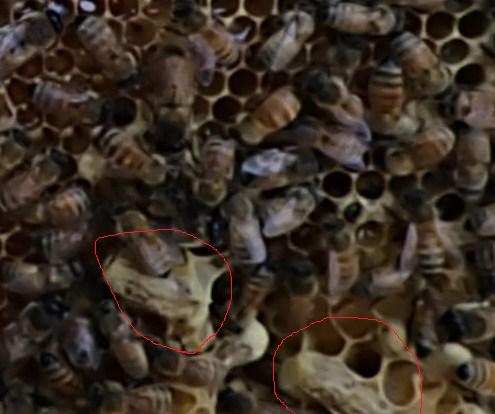
These lumps are on the bottom of a frame and seem to include drone cells and queen cells


Two more queen cells

We've been watching the '14 closely for any kind of weird behavior. The hive has been a bit grumpy with groups spending time outside on the landing board and there are a lot of drones around. Just a couple of days ago, everything changed. The hive seems calmer and more in control of itself. We didn't see a swarm so we don't know if there was one or if there was a queen death and replacement or what happened. Any thoughts from more experienced beeks would be greatly appreciated.

I'm wishing I could give my Dad a call and get some old time beek advice!


Thursday, April 30, 2015

Just adopted about 20-thousand more daughters!

Really! It is true! I now have two daughters, two grand-daughters and about 50-tousand bee daughters. Thank goodness for a husband, a grandson, two sons-in-law and a male dog to add the testosterone to the family!

Last week we picked up our nucleus hive and brought it home. Our club had taken nuc orders and the truck arrived on Wednesday with a delivery of 150 nucs! We brought it home, set it in the yard next to the first hive, opened the door and promised the girls we would move them into their new house the next day.

Nuc waiting to be housed

Installed and flying happy!
The nucs came to us from Grant Stiles, a NJ beekeeper and bee business person, so they are native to the state and relatively local. Other club members and long time beekeepers swear by the quality of the bees they get from Grant so we were happy to be able to get some for our own.

Well, of course, it was cold and rainy and snowy the next day so they had to wait. Then we had freezing temperatures overnight so they had to wait again. Finally on Saturday it was sunny and warm and we were able to put the nuc into its official permanent home.

It was fun to inspect the frames in the nuc and try to find the queen. We always take pictures of each frame so we can more closely inspect them later. I'm happy to say that we had eggs, capped and uncapped brood, pollen, nectar and the queen!


Caught in the act of laying an egg!


Sunday, December 28, 2014

Updates and Plans for 2015


*So it has been warm this Christmas week in northern New Jersey. Bees have been flying here and around the state. Some have been bringing in pollen. Others have been house cleaning.....removing dead bees, stretching their legs and wings, pooping. Yup....they do that too!


Dec. 27, 2015


*The beginning of a new year means new calendars. One of my girls has become a calendar girl. Jim's photo of a honeybee in a cucumber flower was chosen by the New Jersey Beekeepers Association to appear in the 2015 calendar. She's on the May page.


NJ Beekeepers Association 2015 calendar
 
*All the experienced beekeepers and the books say winter is the time to catch up on reading bee literature and to plan for the spring. So that's my plan. In preparation for Spring, we are putting together supers and frames for a second bee hive, getting honey supers in shape and thinking about planting bee friendly flowers. In anticipation of a honey supply, I am investigating types of jars...glass, plastic, size, shape.....there are tons of choices and I'm deciding on a label style for the McBees.

Happy New Year everyone!


Friday, November 7, 2014

Great Ball of Bees part 3

 
OK. This is the final part of the exciting great ball of bees story.
 
 
Just before the discovery of the ball of bees, at the recommendation of the State Bee Inspector, we had inserted 3 Apivar strips into the hive. Apivar is a pesticide used to control the varroa mite which is a real threat to a hive of bees. The strips are supposed to remain in the hive for at least 42 days. After our 2 week inspection of the hive and the discovery of a possible new queen, we patiently waited to open the hive again on the 42nd day of Apivar treatment.
 
Once again, we suit up, gather the gear and open the hive. Things look good. The top super is fuller and heavier than before. The bees are flying in and out and many are loaded with bright yellow pollen. We take pictures of each frame and rotate some from the outer edges to the middle so the bees will fill them. The bees are a bit cranky and they sting Jim several times on the wrist.
 
Moving to the bottom super we see honey, older capped brood but not much and very few eggs or larvae. This is very discouraging and we are now convinced that our first McBee hive is not going to make it through the winter. We take more pictures so we can study them later then we close up the hive.
 
Again I post to the NNJ Bee Facebook page and ask about the condition of my hive.  Within a few minutes I learn that queens slow down their egg production in the fall so the hive doesn't have so many babies to take care of. I also learn that, if bees are bringing in pollen, they are feeding it to the larvae and baby bees. My girls are doing this and it is a very good sign.
 
Later in the day I load the pictures onto the computer and take a good look at the frames and the bees. I see a couple of hive beetles, no mites, honey, brood and..... 
Queen in the middle of the picture

 
There she is! My beautiful italian queen bee is still with us and is still working hard to keep the hive together. I'm so happy that I found her in the hive! The chances of the hive surviving the winter have now increased dramatically. I'm now getting excited for honey harvesting in June.

Some thoughts on cause the ball of bees-
The same day we found the ball, the people who take care of our lawn were using a machine that pokes holes in the lawn to aerate. It is a big machine which thumps and may have vibrated the hive enough to have vibrated the queen right out the door. Seems far fetched, I know, but it is the only explanation we have so far.

Thanks for staying involved in the drama!

Next post- Getting read for winter.


Saturday, November 1, 2014

Great Ball of Bees part 2

For the next two weeks we watch the hive very closely. Everything seems fine. The girls are busy bringing in pollen and nectar. We are supplying them with sugar syrup to help them prepare for winter and they are drinking that stuff like it is going out of style.

We bought 20 pounds of sugar at the grocery store. The checkout person said "What do you do with all that sugar?" "Feed bees" we responded. "Oh" she said and then stopped talking to us.

We impatiently wait the required two weeks and then we don our jackets and veils; gather up the smoker, hive tools, and camera and head to the hive for a close inspection. We remove the top cover and the inner lid. We remove the feeding box and get to the first deep super. Everything looks fine. They are busy building out the wax cells and filling them with syrup and nectar. All 8 frames are not full but there is no lack of work being done. This makes us happy.

Capped and uncapped brood
 

Honey, brood and a drone cell in the middle

We take off the top super and begin inspecting the bottom 8 frames. Some frames are full of honey and capped brood. Others look like they have larvae in them and maybe eggs. This is very encouraging because it means the queen settled back in and continued to do her work.

Then we see this-


What is that lump among the brood cells? Back to the books and the experts so we can understand what it is and what it means. This hive has more drama than a house full of teenage girls!
 
Seems the lump is a queen cup which means the bees decided to make another queen either because the present one is hurt or missing or she just isn't productive enough. We think she is still in the hive. There are eggs and larvae which shows that she's been doing something in the last 2 weeks. since it is now mid September and winter is around the corner, it is too late to add a new queen and have her be successful enough to overwinter. We are fairly sure we are going to lose our hive.
 
Now I've been around bees long enough to know that hives don't all make it through the winter. I also know that we got our hive started later than is usual and it was a risk we were willing to take but I still feel sad thinking that I had somehow let the girls down. I'm not looking forward to having to clean out a dead hive in the spring. So it looks like the ball of bees really was a bad thing.
 
 
Next post- Ball of Bees part 3


Thursday, September 11, 2014

Class Trip to the Bee Hives

Twice a year my workplace closes to the public and holds a day of training, learning, food and fun, also known as SSL Staff Day. During that time, we have breakfast, meet together to learn something new or train on new equipment; have lunch; share our knowledge with workshops or other training; have a snack; have a department meeting and call it a day. We are famous for our eating!


BCC Library Staff in the meadow
This August 21st, the afternoon fun was a trip to the BCC bee hives with me. I offered this idea up, sort of as a joke, because so many of my co-workers are afraid of bees and just as many are very curious about the entire process. The boss took me up on the offer so we met at the bee hives after lunch. it was a lovely summer afternoon and a nice time of day to be outside so most people didn't mind taking a short walk. Plus, the boss said attendance at the hives was mandatory, so they all came. I had hope to be joined by the actual owner of the hives, but he was not available. I did ask his permission to go into the hives.

I opened a hive and pulled out frames which were empty of honey,nectar or brood because they had been extracted not too long ago.


frame with eggs,brood, bees & honey

empty frame
I got to show them what actual honey comb looks like and explain that the bees determined that shape by themselves and that is the shape they like to function in. I answered questions and got to tell the story of helping my father with his hives which led to more questions.


 Even the College's public relations guy, Larry, came and took pictures!


Sharing my new hobby made me realized how many of my childhood stories revolve around the bees (future blog posts formulating!)  and what an interesting childhood I had and helps explain why I have a connection to nature that many other people don't have. 


Tuesday, August 12, 2014

Bee-vangelism or spreading the word and enlisting converts

One of the dictionary definitions of "evangelism" is "a militant or crusading zeal". While I have always been a proponent of bees and beekeeping, I guess now I have become an evangelist or a Bee-vangelist! (I can hear the groans from my pun loving friends John and Roger)  My husband has also become a bee-vangelist telling everyone he knows that his wife is a beekeeper and he is right there with me, in the hive, visiting the bee supply stores and browsing the catalogs. He joined in the extracting fun at my workplace and he even thinks he can find a place for a hive or two at some of his work sites.

Our crusade worked on a colleague at my workplace as well. A professor with a strong interest in the environment and sustainability came by to learn about the extracting process. He was so excited about it, he called his wife and asked her to come by, with their teenager daughters. After some teenage reluctance, all three arrived and within a few minutes, they were all working. They uncapped frames, cranked the extractor, and stuck labels on jars. At one point, one of the girls had a drone bee walking around on her hand. Before the afternoon was over, the professor was hooked and talking about getting his own bee hive and his daughter was thinking of designs for the jar label.


My nephew in Vermont has been converted as well. His conversion came from my dad, his grandfather. My nephew and his wife are caring for their first hive this summer and we share updates. Their enthusiasm is not dampened by the shorter summer in northern Vermont or the shorter growing season. In this picture, Steve is adding a honey super and is well protected.

photo courtesy of Brianne Ragno
 
Oh, and my son-in-law is a convert too! He says he's willing to put a hive in his backyard (although he might just be trying to stay on my good side!) but his wife, my daughter, is not yet ready for that. Dogs and babies come first. 

Yup, and 2 of my high school classmates, who are also Facebook friends, have contacted me about bees and beekeeping. One of them lives in Hawaii so I'm volunteering to go visit and help Michael with his hives! I had honey from a lavender farm in Hawaii and it was exquisite!
http://www.aliikulalavender.com/p-21-lavender-honey.aspx

One more...a neighbor with a young son who has a tortoise, a lizard, a dog and is in to all sorts of outdoor sports came over recently and got very excited about the bees. Now he's borrowed my books, wants to come watch when we go into the hive again and getting educated so he can have a hive next spring.

With all the news about the importance of honeybees for our food and the collapse of bee hive colonies all over the world, I can only hope that more people catch bee-vangelism fever and become crusaders.


"Evangelism." Merriam-Webster.com. Merriam-Webster, n.d. Web. 18 July 2014. <http://www.merriam-webster.com/dictionary/evangelism>.

Saturday, July 5, 2014

Hypochondriac Panic Attack- Bee Hive Style

Ever get a pain and decide to search the internet to see what it might be only to discover that the pain could be the beginnings of a rare and terrible disease and then remind yourself that you have other symptoms? Thanks to Web-MD and other sites, it is really easy to self-misdiagnosis or become one of the world's leading hypochondriacs. The internet is really helpful for providing misinformation.

So that's what I did this week with the bees. I misdiagnosed and scared myself and I should know better. I am a librarian by profession and teach information literacy classes to college students. 

 On Tuesday July 1 I went into the hive to see what was going on. The girls had been in that hive for about 10 days. From the outside, I could see plenty of activity but I really wanted to know what was going on inside. So I donned the veil and entered.

I saw some positive stuff inside. I could see 2 full frames of honey and 2 full frames of brood and honey. There were still 3 new frames that hadn't been touched yet. There was another frame that sort of looked ok but caused me some concern.


I take pictures whenever I go into the hive. This helps me to later remind myself of what I saw and lets me enlarge the pictures to take a closer look at stuff. So I took pictures of the frames, closed up the hive and said good night to the girls.

Looking at the pictures on the computer monitor, that one frame just didn't look right. First, the foundation and the cappings are really dark in color. I know that this frame came in the nuc box and was probably used when the guy put the nuc together which would account for some of the coloring, but still it seemed dark. Second, there was capped brood but it was all over the frame, not nicely nestled together in a sort of oval shape with honey on the outside edges. Third, I could see into some of the cells and I saw pupae and larvae in various stages, liquid of some sort, some solid looking bits that were gold in color and some empty cells. 


Grabbing my trusty books, I began to look at pictures and descriptions of bee hive diseases and illnesses. Oh no, looks like foul brood of some type. Nope, wait, looks more like     I "googled" for more information and pictures and came away more depressed. My bees had a disease and I didn't know what one or what to do.

Wednesday morning I decided to ask the experts and posted the picture of my frame to the Northeast New Jersey Beekeepers Association FaceBook page and said I was concerned about this frame. I did not say what my concern was or what my several diagnosises (?) were. Then I waited for the cry from other more experienced beekeepers telling me I had to destroy my hive or quickly medicate the bees or some other action to save them.

Guess what happened? The responses were quick and positive. Nothing wrong with my bees. the experienced beeks said I was being over anxious and what they say in the frame was hatched brood, new eggs and larvae and happy bees.
Big sigh of relief from me.  thanks fellow beeks for keeping this new beek from having a bee panic attack!

Tuesday, June 24, 2014

Help! We're being robbed.....Oh, wait....nevermind

June 22, 2014-

Out all day. Got home around 2:30 this afternoon, let the dog out and went to check the bees. What the heck is going on?  Bees are flying all over the front of the hive, in and out, up and down, back and forth. Hundreds of them.

I know about bearding, when they collect on the outside of the hive as a way to cool down, but this wasn't bearding. They weren't swarming because they weren't going anywhere, just flying in front of the hive. Were they being robbed? Oh no....What do we do about that?


Quick....to the books!  Thank goodness for the books. Looked up robbing and got this "...normal activity at the hive's entrance can look unusually busy. This is when young worker bees take their orientation flights. Facing the hive, they lover up and down, and back and forth. They're orienting themselves to the location of the hive. You may see hundres of these young bees floating around the front of the hive, but there's nothing aggressive of frantic about theie exploratory behavior." (Blackiston, p. 180)

False alarm. No robbery in progress, just worker orientation!


My go to books so far:

Blackiston, H. 2009. Beekeeping for Dummies. Hoboken, NJ: John Wiley & Sons.

Morrison, A. and Vilauib, M. 2013. Homegrown Honey Bees. North Adams, MA: Storey Publishing.


Note: If you are thinking about buying books and you go throught he link for my club, the club makes a little cash- http://www.nnjbees.org/books/


Sunday, June 22, 2014

Look Ma, No Gloves!

June 21, 1014- Day 3-
I did it! I successfully moved 5 frames from the nuc box into the brood box and did not get stung. Of course I was dressed in a jacket, long pants and a veil, but no gloves. All the experienced beekeepers, Dad included, say not to use gloves because they make you clumsy.

First step- Assemble all the necessary stuff:


  • brood box
  • lid
  • sugar syrup
  • top feeder
  • hive tool
  • bee brush
  • smoker
  • hat
  • veil


Next- Drink some more coffee and wait for the sun to warm up the hive. This is a good move since many of the foraging bees will be out working so there won't be so many bees to disturb.

Light the smoker and let it get a good burn going. I am using Dad's smoker which has a lot of years on it but still works great. Opened it up to find some of his burlap still inside. Thanks Dad!


 Don the gear and get going-

 
Hello Bees
Opening the nuc box

5 frames inside the nuc box
Looking for the queen

3 frames moved out
Brood, honey and workers


There she is. a beautiful italian queen bee


Here they are in their new home behind the vegetable garden
 Very proud of myself! No gloves, no stings and they seem to have taken to their new home.

Hint: Take digital pictures of your work. If you don't see the queen or eggs or whatever you are looking for, you may see it when you put your photos on your computer screen and enlarge them. I did not see eggs when I made the transfer, but when I looked at the pictures later, and enlarged them, ta da!...eggs!


Saturday, June 21, 2014

What's in a name

My entire life has been spent around honey bees. My Dad was a hobbyist beekeeper who, in his later years, ran a small bee supply shop from his garage. Sometimes when he was working with his hives, he would bring me a drone bee to play with. Drone bees are the males. They don't sting and are usually put out of the hive by the other bees. He would bring one to me and I would let it walk around on my hands until it flew away.

 Sometimes I went with him when we was called to pick up a swarm. Swarms land in the oddest places, a mail box, a bench in front of the library, and they always attracted a crowd. One thing that really bothered him was people saying "Don't you get bitten?" "I don't want them to bite me" "I got a bee bite"

Have you ever seen a honeybee's face? They don't have teeth. They sting from their backside and they only do that when they have no other option because when they sting, they die. OK, so now Dad's pet peeve is mine. That's what the name of this blog is about. Honeybees do not bite!

June 19, 2014- Day 1- While I have many, many years of knowledge, I have practically no hands on experience with beekeeping but that is about to change! This morning, in the pouring rain, I picked up a nuc from a local beekeeper and deposited it in my backyard on the hive stand where it will live. Nuc, short for nucleus hive, is a small function beehive with workers, a laying queen, drones and various phases of eggs and larvae.  Later today or maybe tomorrow, I'll move the girls and their brothers and mother into a new bigger house where they will, hopefully, work hard and live happily and get themselves through the winter. That's my hope for them. Next year, I will hope for extra honey for me, this year, survival is all I want.


Adjacent to my yard there are 2 mature American Chestnut trees which is rare. American Chestnuts were nearly wiped out in the 1950s because of a blight. These trees flower in early June with long strings of blossoms called catkins which are very stinky, not fragrant, just stinky. When the blossoms wither and fall off the tree, they really smell bad and they make a collective mess which has to be raked up. Anyway, the trees are in bloom and the new bees are loving them! At first, we wondered where they bees were going since they were coming back with full pollen baskets but we didn't see them on any ofour flowers. Then we looked up. The chestnut trees were full of bees...my bees! Our family nickname for those trees is "stinky tree" so I may have "stinky tree" honey!


June 20, 2014- Day 2- Decided not to transfer the bees into the real hive until tomorrow. I'm thinking they just need some time to adjust to having moved from their original home. The dog is curious about them. We walked near the hive and watched as they flew around. He was having a hard time keeping track of all of them so he gave up and came back to sit on my lap.